Every few months, we see the same pattern play out.
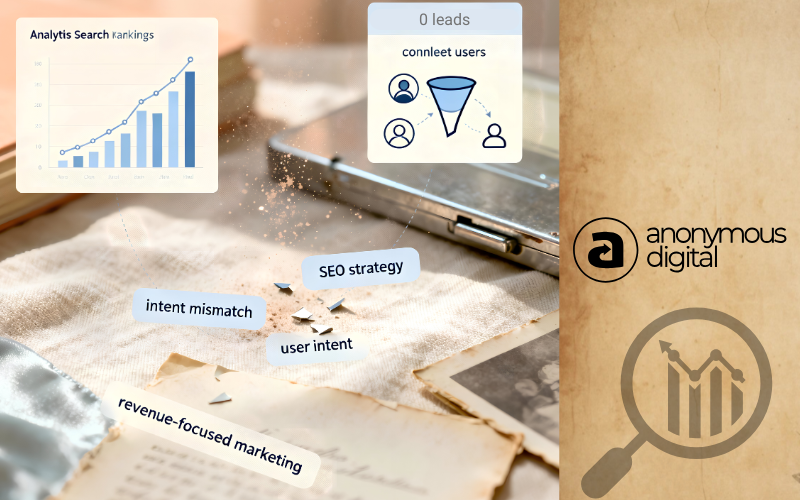
A business proudly shares screenshots of rising traffic graphs. Rankings are up. Keywords are on Page 1. Reports are full of green arrows.
Then someone asks a far less comfortable question.
“What about leads?”
“What about revenue?”
That is usually where the conversation goes quiet.
At Anonymous Digital, we often call this the Traffic Trap. It is when businesses mistake visibility for value and momentum for money.
If you are ranking well on Google but your inbox is still empty, you do not have an SEO problem.
You have a strategy misalignment.
Your digital stage is built. The lights are on.
But the audience is sitting in the wrong theatre.
Why Ranking Alone No Longer Means Anything
Search engines have changed far more than most reports admit.
In the current Andromeda era, where AI systems evaluate user intent with far greater precision, Google and Meta are no longer impressed by volume alone. They are increasingly focused on why someone is searching, not just what they typed.
In practical terms, this means search engines can now distinguish between
Someone who wants to learn
Someone who wants to compare
Someone who wants to hire
If those audiences are combined, traffic increases while leads decline.
At Anonymous Digital, this is one of the most common reasons we see high-ranking websites fail to convert.
The Real Leak Intent Mismatch
Consider this example.
A premium corporate law firm ranks number one for “What is a contract?”
The traffic looks impressive.
But the audience consists largely of students, early learners, and casual researchers. The firm has built authority in the wrong place.
Ranking is not the problem.
Intent mismatch is.
Revenue does not come from popularity. It comes from relevance.
How Anonymous Digital Selects Keywords That Pay
The most valuable keyword is rarely the most searched one. It is the one closest to a buying decision.
When we evaluate SEO opportunities, we filter every keyword through three revenue focused lenses.
1. Transactional Intent
We prioritise terms that signal a state of need.
Examples include
“Best service for industry”
“Service pricing”
“Service agency near me”
These keywords often have lower volume, but dramatically higher conversion potential.
2. Pain Point Specificity
The strongest inbound leads come from people searching for a solution to a specific problem.
If a keyword describes a headache clearly, it usually converts better than a broad industry term.
3. Competitor Gaps
We look for areas competitors ignore.
Most brands chase broad keywords. Few invest in niche, commercially sharp queries. Those gaps are where revenue hides.
Check: https://www.linkedin.com/feed/update/urn:li:activity:7411269741547425792
The 10 30 60 SEO Mix We Use
A sustainable SEO strategy is not built on a single type of keyword. It is an ecosystem.
At Anonymous Digital, we follow a simple balance.
10 percent Floodlights
High volume industry terms that build long term brand equity but rarely convert immediately.
30 percent Connectors
Mid volume comparison and decision stage keywords that capture users evaluating options.
60 percent Snipers
Low volume, highly specific keywords that generate the most qualified leads.
These terms may only receive 50 searches a month, but the intent is unmistakable.
When someone searches for “performance marketing agency for sustainable fashion brands,” they are not browsing. They are buying.
The Technical Layer Still Matters
Strategy fails if the foundation breaks.
Even with the right mix of intent, your digital stage must function smoothly.
In today’s environment
Core Web Vitals are non-negotiable
Mobile performance is mandatory.
Schema markup is no longer optional.
Schema acts as the technical language that explains your business to search engines. It increases visibility in rich results and clarifies commercial relevance.
Speed and usability determine whether intent converts or vanishes.
The Bottom Line
If your SEO strategy exists only to win rankings, it is incomplete.
Businesses do not grow on traffic alone. They grow on high-intent inbound momentum.
At Anonymous Digital, SEO should be treated as an asset, not a decoration. If it does not generate business, it is not working.
Stop optimising for digital wallpaper.
Start engineering a stage that pays for itself.
Curious how many of your current rankings are vanity versus value?
Happy to discuss how we identify revenue keywords that most strategies miss.